TimeMatrix Features · Practical Tutorial
Institutional Holdings: A Step-by-Step Tutorial
Explore SEC Form 13F holdings across 17 quarters, September 2022–September 2026, with top-20 manager rankings, reported positions and quarterly comparisons.
This guide is public. Institutions requires sign-in. Unpaid accounts can inspect retained Apple/AAPL reported positions; broader holdings search requires member access.
Step 1
Select a report period
Open Screeners → Institutions. Start by selecting an available report period. A period is a quarter-end holdings date, not the date on which you are viewing the page.
Form 13F is quarterly and normally due within 45 days after quarter end. The holdings were historical when filed and can have changed again by the time you read them. Available periods depend on retained, validated filings.
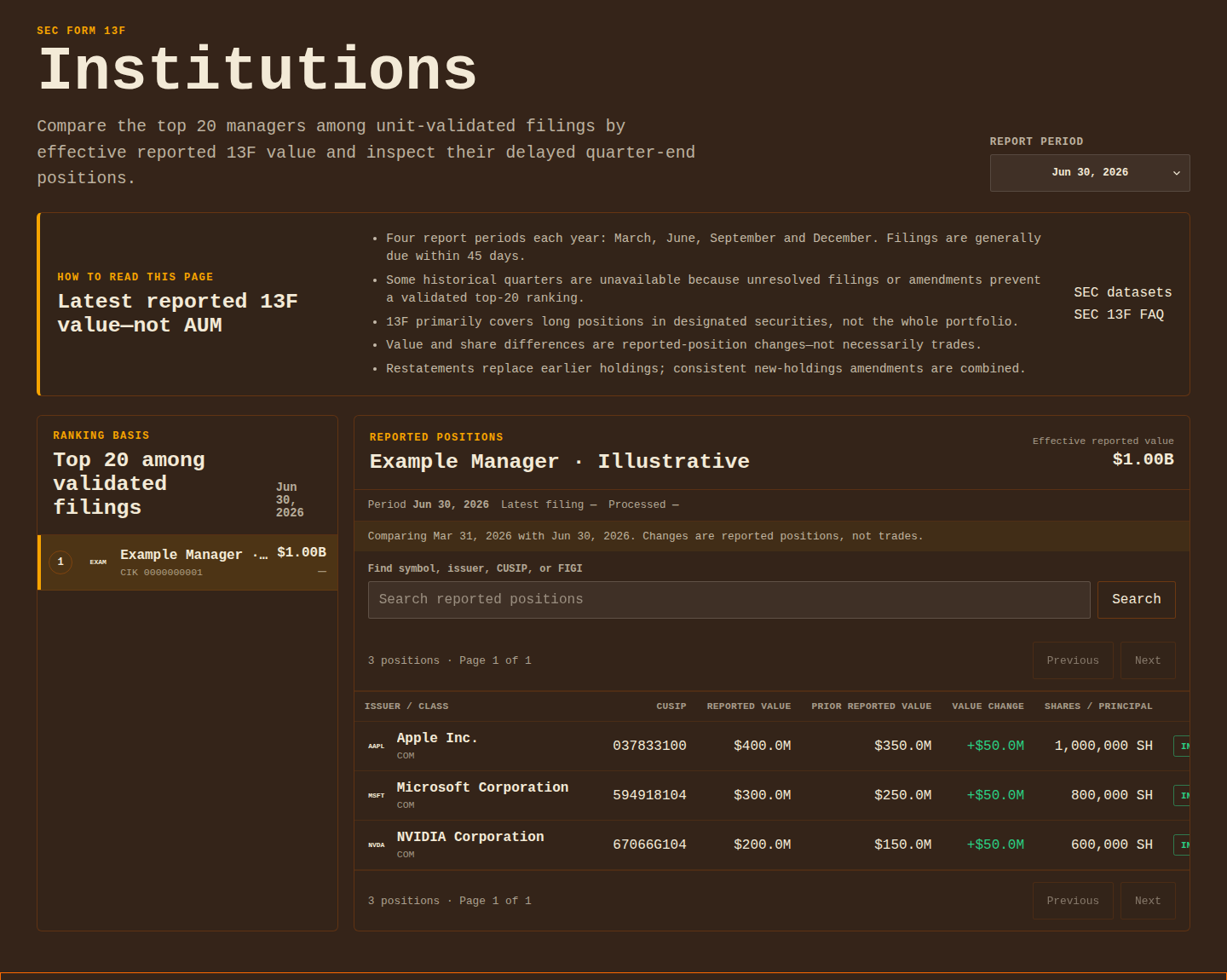
The example below uses a fictional manager and three illustrative positions to identify the controls. Its values and manager count are not SEC filing data or the size of the live ranking.
- Choose an available report period from the page control. The next quarter is also listed as Next · Not available; select it to read the release conditions without displaying older holdings under the new date.
- Note the quarter end and compare it with the filing and processing dates shown for the selected manager.
- Keep the period fixed while comparing managers.
Step 2
Available history
As of November 17, 2026, Institutions includes 17 consecutive reporting quarters from September 30, 2022 through September 30, 2026, with 20 ranked managers in each quarter. All four quarters of 2023, 2024 and 2025 are available, along with March, June and September 2026.
The page supports a rolling five-year reporting window, but the current coverage is not five complete years. December 31, 2021, March 31, 2022 and June 30, 2022 remain unavailable because their rankings have not passed validation. Use the report-period menu for the latest available coverage.
Step 3
Choose a manager from the reported-value ranking
The ranking covers the top 20 managers among unit-validated filings by effective Form 13F reported value. It is not a ranking of total assets under management, influence, or live portfolio value.
Select a manager to inspect Reported positions. Effective values reflect the filing components retained after amendment handling, rather than adding every original and amended filing together.
- Select one manager in the ranking.
- Read its Effective reported value and freshness summary.
- Note any omitted or unavailable information before comparing it with another manager.
Step 4
Find a reported position
Use Search reported positions to look for a covered issuer or symbol, then select Search. Unpaid access is limited to retained Apple positions and disables broader asset search.
Read Issuer / Class and CUSIP together. Different classes or reported instruments should not automatically be treated as the same common-stock holding. The Shares column can represent shares or principal according to the report.
- Search for a company such as Apple when available in the chosen manager’s report.
- Inspect the reported value, shares or principal, and status for the matching row.
- Use pagination to review the rest of the results; an empty search does not establish that the manager has no other economic exposure to that company.
Step 5
Interpret quarter-to-quarter differences
The comparison uses the immediately adjacent prior calendar quarter when available. Read Reported value, Prior reported value, and Value Change together. An unavailable prior comparison is not zero.
An illustrative change from $100 million to $120 million is a $20 million increase in reported value. It does not establish a $20 million purchase: price movement, changes in quantity, corporate actions, and filing coverage can all affect the comparison.
Position statuses describe what the available reports show. They are not a transaction ledger with trade dates or execution prices.
Step 6
Use the filing context alongside company research
Form 13F primarily covers long positions in designated 13(f) securities. Shorts, many other assets, confidential omissions, and activity after quarter end are outside this view. It is not a complete manager portfolio.
Record the manager, report period, issuer/class, reported values, prior-period availability, and filing date. Use the page’s SEC datasets and SEC 13F FAQ links for the reporting context.
Compare reported ownership with company fundamentals and chart history only after aligning their dates. A delayed filing does not indicate what the manager is buying today.
Common questions
How much institutional holdings history is available?
As of November 17, 2026, TimeMatrix provides 17 consecutive reporting quarters from September 30, 2022 through September 30, 2026, with 20 ranked managers per quarter. The reporting window can cover five years; December 2021, March 2022 and June 2022 remain unavailable pending ranking validation. Check the report-period menu for current coverage.
Why are there fewer than four available periods in some years?
There are four quarterly report periods: March 31, June 30, September 30 and December 31. TimeMatrix only lists historical periods with a validated top-20 ranking. Some imported quarters are withheld because unresolved filings or conflicting amendments could change that ranking. These gaps do not mean institutions skipped their quarterly reports.
When should the next reporting period appear?
The next reporting period appears once its filings have been imported and its ranking has passed validation. Until then, the menu shows Next · Not available. TimeMatrix checks individual EDGAR filings daily and reconciles them with the quarterly bulk archive later. The page does not provide an estimated release date.
Why can newer filings exist before a reporting period appears here?
Individual 13F filings can appear on SEC EDGAR before the quarterly bulk dataset. TimeMatrix checks the complete EDGAR filing index daily and publishes a quarter after its filings and amendments pass ranking validation. The next-period entry is an availability preview, not a promise that the quarter has no filings or a guaranteed release date.
Are these the institution’s current holdings?
No. These are reported quarter-end positions, published after a filing delay and subject to the dataset’s retained coverage.
Does Value Change measure buying and selling?
No. It is a reported-value difference. Price changes and other factors can contribute, and trade execution details are not supplied.
Why is this different from assets under management?
Form 13F covers a defined subset of reported securities. Total assets under management can include many positions and assets outside that subset.