Panic years
Years the card associates with financial panic or acute stress.
Historical Market Cycles
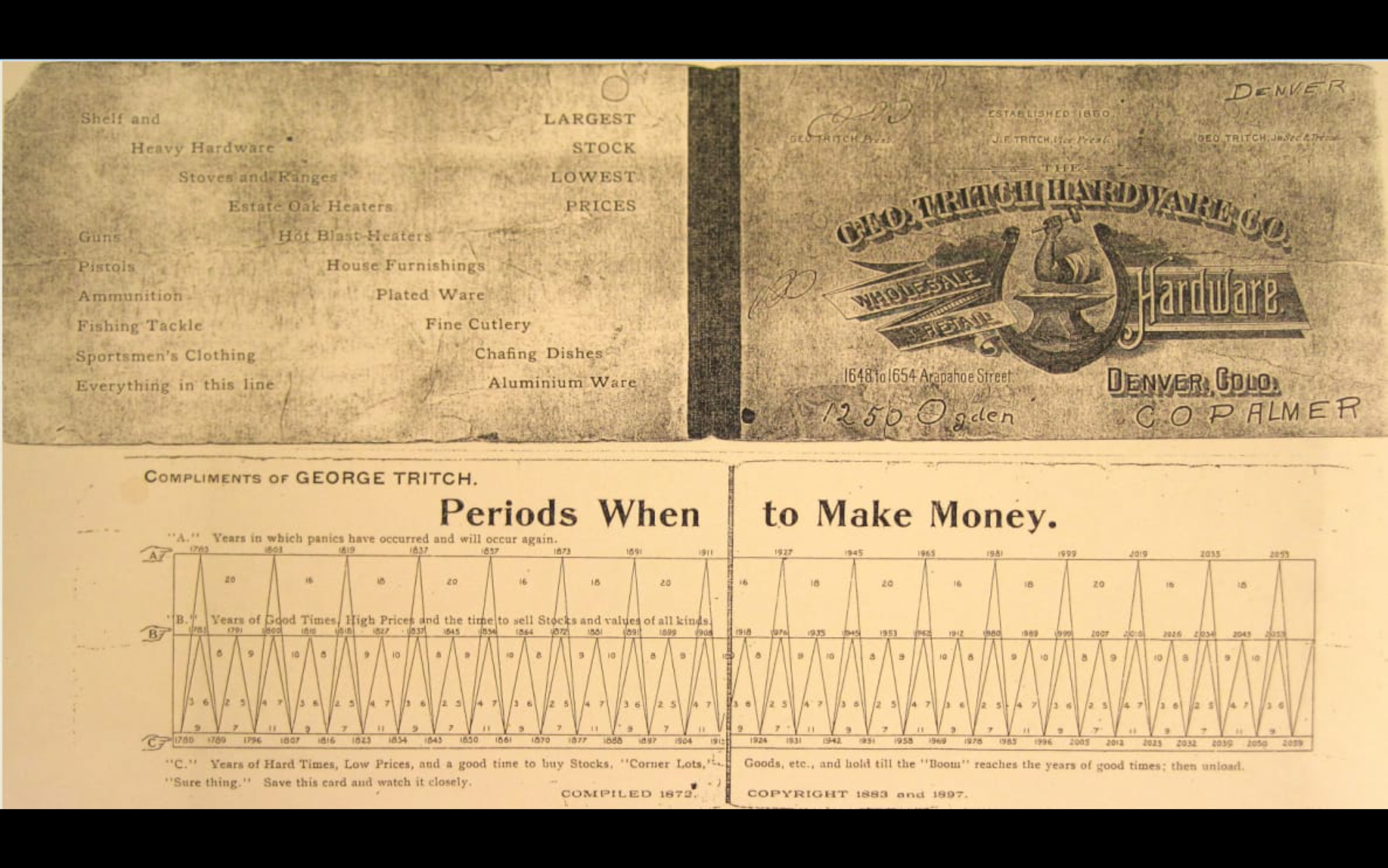
Explore a late-19th-century market-cycle card, learn how its three printed rows were intended to be read, and separate the historical idea from a modern, tested forecasting method.
Read The Original
These labels summarize the language printed on the card. They describe its historical theory; they are not promises about future prices.
Years the card associates with financial panic or acute stress.
Years the card historically framed as favorable times to sell.
Years the card historically framed as favorable times to buy.
Primary Source
Interpretation
What It Is
The card organizes selected years into recurring categories of panic, prosperity, and depression. It belongs to a 19th-century tradition of looking for repetition in business and commodity cycles.
What It Is Not
The printed sequence is not a modern backtest, a guarantee, or a complete explanation of market behavior. Treat it as a research artifact and test any cycle claim against independent data.
Provenance
The scan identifies George Tritch Hardware Co. of Denver and reads “Compliments of George Tritch.” Its visible text says “Compiled 1872,” while the copyright line at the bottom shows 1883 and 1897. This page describes the object by what is printed on it and does not present it as an original W. D. Gann document.
Image recordWikimedia Commons public-domain scan